A plan approved by the War cabinet to send 1000 Canadian troops from Britain to capture forts at Trondheim was postponed for six days after Chiefs of Staff feared high casualties.
One of Chamberlain's secretaries wrote in his diary that the Norwegians would 'lose heart unless quickly assured of substantial support'.(cited at: Gilbert, M, Second World War).
Two Norwegian submarines were scuttled by their own crews on April 16th 1940 in Verbukta at Tonsberg.
I have included a Movietone newsreel clip from the period, what is obvious in the struggle of the Allies is the Germans' air superiority. No anti aircraft guns or fighter aircraft to defend the British are lacking, little wonder Norway was a failure.

Thursday, 16 April 2015


Wednesday, 15 April 2015
#WW2 April 15th 1940 #NorwayCampaign
 |
| General Carton de Wiart, found at: http://badassoftheweek.com/images/30045813384/wiart1.jpg |
On April 15th 1940 The codebreaking team at Bletchley Park broke the Enigma code used by the German army and Luftwaffe. Unfortunately there was no team to analyse the information, and no way of transmitting information directly to British forces securely http://www.bbc.co.uk/history/ww2peopleswar/stories/08/a6841208.shtml.
Further British reinforcements for Alesund were delayed by gales off Scotland.
Troops at Namsos reported snow 4ft deep. The British Commander General Carton de Wiart was unable to leave the flying boat he had arrived at Namsos in due to German machine gun fire.
Night time temperatures fell to zero degrees farenheit. Frostbite was reported,
Other British troops held positions at Harstad, Salangen and Bogen, all suffering in the harsh conditions.
In the south of Norway the Norwegian 3rd Division surrendered to the Germans at Sedestal. 2000 soldiers surrendered.
Tuesday, 14 April 2015
#OnThisDayIn1940 #WW2 Royal Marines Land At Namsos April 14th 1940 #NorwayCampaign
 |
| Norwegian Campaign Map April may 1940, found at:https://historicalresources.files.wordpress.com/2008/09/norway.jpg |
On April 14th 1940 350 British Royal Marines landed at Namsos, Norway to prepare for the arrival of the 146th Territorial Brigade, the first British troops to land in Norway.
German paratroopers of the 7th Flieger Division landed at Dombas, Norway, they suffered heavy losses due to landing in the middle of the camp belonging to the Norwegian 11th Regt. Unfortunately they were still able to damage nearby railways and occupied farmhouses causing logistic problems for several days.
 |
| HMS Sterlet, found at:http://www.battleships-cruisers.co.uk/images/hmssterlet.jpg |
Out at sea, British submarine HMS Sterlet damaged the German gunnery training ship and minelayer Brummer in the Skagerrak (between Sweden and Norway). The Brummer sank the next day.
 |
| Brummer before #WW2, found at:http://www.kbismarck.com/photo100.html |
Monday, 13 April 2015
#WW2 #OnThisDay1940 Second Battle Of Narvik April 13th 1940
 |
| HMS Warspite, found at:http://ww2today.com/the-second-battle-of-narvik |
On April 13th 1940 The Royal Navy with 9 destroyers screening the battleship HMS Warspite, attacked 3 German destroyers and a submarine at Narvik. The Swordfish biplane launched from HMS Warspite attacked and sunk the submarine taking damage from the U-Boat's anti-aircraft gun. The three German warships were sunk by a combination of shell fire from the Royal navy ships and the Fairey Swordfish.http://ww2today.com/the-second-battle-of-narvik
#WW2 #OnThisDay1940 April 12th 1940 Hegra Fortress Occupied By Norwegian Forces
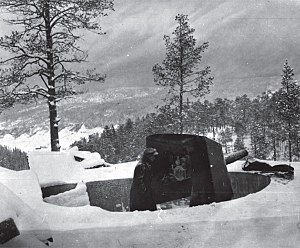 |
| Gun position at Hegra Fortress, found at:http://upload.wikimedia.org/wikipedia/commons/thumb/8/84/Hegra_Fortress_gun_position.jpg/300px-Hegra_Fortress_gun_position.jpg |
Hegra Fortress in the Nord-Trondelag (Southern) area of Norway had been mothballed and was to become a place of resistance until May 1940. The fort had been left unoccupied for years, but the fort was to become famous in April and May 1940, when Major Holtermann with his force of 250 men (and one woman) withstood the German onslaught for 26 full days. The fort was defended by 10 artillery pieces of varying calibre, able to fire to a range between 6 & 9km.http://www.absoluteastronomy.com/topics/Battle_of_Hegra_Fortress
Today the fortress is a museum and looks well worth a visit: http://www.visitnorway.com/uk/where-to-go-uk/central/trondheim/what-to-do-in-trondheim/attractions-in-trondheim/hegra-fortress/
Saturday, 11 April 2015
#WW2 On 11th April 1940 In Norway...
On 11th April 1940, German forces advanced so to link up from Oslo to Trondheim.
Why was Britain and France involved in Norway? The reason was its neighbour - Sweden. In winter, iron ore from Sweden was exported from the Norwegian port of Narvik - whoever occupied Norway would control the supply of iron ore to Germany. If Britain controlled the Norwegian ports, the North Sea would be virtually closed to the German navy, and the Baltic would be in striking distance.
The German ship Lutzow was badly damaged by the British submarine HMS Spearfish, as a result Lutzow returned to base on April 18th 1940.
Why was Britain and France involved in Norway? The reason was its neighbour - Sweden. In winter, iron ore from Sweden was exported from the Norwegian port of Narvik - whoever occupied Norway would control the supply of iron ore to Germany. If Britain controlled the Norwegian ports, the North Sea would be virtually closed to the German navy, and the Baltic would be in striking distance.
#WW2 The Blackburn B-24 Sea Skua Carrier Aircraft
 |
| Blackburn Sea Skuas on deck of HMS Ark Royal, image found at:http://media-cache-ec0.pinimg.com/736x/d0/d2/3b/d0d23b34fcba0e724e7022d46459b8ae.jpg |
I thought I would get some info on this aircraft as it took part in the Norway campaign on the carrier HMS Ark Royal. On 10th April 1940, 16 Skuas from the Orkney Isles sank the Konigsburg in Bergen harbour, this was the first time a destroyer had been sunk by aircraft alone. It was withdrawn from front line service in 1941, as it was too vulnerable to attack by land based fighters such as the Me-Bf109.
 |
| Diagram of Blackburn Skua found at:http://home.online.no/~oela/Skua%20snitt.jpg
Powered by a Bristol Perseus XII radial engine of 890 hp, the Skua was armed with 4 x .303 in forward firing Browning machine guns and a single flexibly mounted .303 in Lewis or Vickers K machine gun in the rear cockpit. It also had the capacity to carry a 500 lb bomb mounted under the fuselage and up to 4 x 40 lb or 8 x 20 lb bombs in racks under each wing.http://www.tangmere-museum.org.uk/aircraft-month/blackburn-skua
Other Specifications
Crew - 2
Max range - 435 miles
Service Ceiling - 20,200ft
Max Speed - 225mph.
|
 |
| Skuas in flight, found at:https://blogger.googleusercontent.com/img/b/R29vZ2xl/AVvXsEjE04_RXfru99pdGrqM8ZIydgS0De4ZDCcb4GxVqs1EblHrrQsLGle3HenUjg6eri53Us11y2xdPT0V08bvZTRfmeIIp9qioEJjpS5yDOLUwV807lAJBRg73FStqJnIVdfADoaEV_jyulUb/s1600/Blackburn_B-24_Skua.jpg |
Friday, 10 April 2015
#WW2 #OnThisDay1940 10th April 1940 The First Battle Of Narvik
 |
| HMS Hunter sunk at First Battle Of Narvik, found at: https://lh3.googleusercontent.com/-c02WufFlBsM/UOuVjacSJYI/AAAAAAAAjPU/oxlRj8ljbRg/s800/HMS_Hardy_1936.jpg |
On this day in 1940 The First Battle Of Narvik took place.Five British destroyers took on ten German destroyers and shore batteries near Narvik, (Ofot Fjord). 2 destroyers from both sides were sunk; Hardy & Hunter (British) and Wilhelm Heidkamp & Anton Schmitt (German).Three German destroyers were also damaged in the daring British attack. Eight German merchant ships and one ammunition carrier also were sunk. The British submarine Thistle was sunk by U-4 off Stavanger.
It was no victory for either side, but the British had made their presence felt, and the Germans had half their destroyers put out of action.
 |
| Wrecked shipping at Narvik, found at:http://i4.minus.com/ibkaLRXtEBFfzU.jpg |
Thursday, 9 April 2015
#WW2 End Of Phoney War - On This Day Denmark & Norway Invaded By Germany #OperationWeserubung

Today in 1940 Denmark was invaded and captured by German forces - notably 170th & 198th Infantry Divisions. Norway was also attacked, Egersund and Arendal captured without any resistance.
#WW2 The Messerschmidt Bf 109 or #Me109 One Of the Biggest Hoaxes Of The Second World War
 |
| Me109 found at:http://www.flugzeug-bild.de/name/galerie/kategorie/historische-flugzeuge~militaerische-propellermaschinen~messerschmitt-me-109.html |
The Me-109 first saw action with the Condor Legion in the Spanish Civil War 1936 proving itself a useful fighter aircraft. Four months before the beginning of The Second World War, the Me-109 was declared to be a record holder of 469.22 m.p.h.
This was not an Me-109, it was an Me209VI, but the F.A.I (Fédération_Aéronautique_Internationale) had not been told. They can't have looked very hard either.The aircraft looks totally different.
 |
| Me209 VI found at:http://upload.wikimedia.org/wikipedia/commons/0/0d/Messerschmitt_Me_209.jpg |
At the outbreak of the Second World War the Germans had some useful propaganda - declaring they had the world's fastest fighter aircraft. The Battle of Britain would help dispel the myth.
Subscribe to:
Posts (Atom)