Thursday, 29 May 2014

#D-Day70 6th June 1944 Airborne Troops

There won't be many people who have not heard of Stephen Ambrose or Band of Brothers - the excellent book he wrote about Easy Company of the 101st U.S Airborne Regt, which  was adapted for television. One of the best Christmas presents I ever received from my other half was the box set of Band of Brothers, available at http://amazon.co.uk and other good outlets. I'm not solely writing about U.S involvement on D-Day, the common view is that there is so much publicity about American involvement that they forgot that it was also British, Commonwealth and Allied European troops who took part in the fighting.

There are plenty of excellent books out there, in particular I do enjoy reading Pegasus Bridge by Ambrose, which goes into detail about the British 6th Airborne. It's origins, training, the people who took part, the landings and action after D-Day. These men were tough. They had to be. Howard during training like the rest of D Company marched the men from Devonshire to Bulford, 130 miles in 1942. (Ambrose, p.p 35,36).
They trained at night and slept during daylight hours, this was unheard of at the time, but because of good training, on D-day itself 6th Airborne successfully captured the 2 bridges over the River Orne at Ranville and the canal bridge at Benouville (later called Pegasus Bridge). Taken to their destination in towed Horse gliders, the glider pilot training also paid off, landing with pin point accuracy next to the bridges and not in the canal or river. The bridges would be held until relieved, as they were vital for the allied advance inland on the outskirts of Caen.


British Paratroopers also took part in the battle in the early hours of the 6th June 1944. the Merville Battery was a target as it covered the coast, in particular Sword Beach http://www.bbc.co.uk/history/worldwars/wwtwo/dday_beachhead_01.shtml. Like most Paratroopers on D-Day, most were scattered over a wide area considerable distances from their objectives. To attack the battery Lt-Col Otway could only muster around 150 men, instead of 650 (See this link on the BBC History Website :http://www.bbc.co.uk/history/worldwars/wwtwo/dday_audio_04.shtml .The battery had to be taken before the seaborne landings took place, Otway had to attack as planned. The Paras went ahead, won the battle capturing around 30 Germans.
Plan Of Attack of Merville Battery
Observation Photograph Of Merville

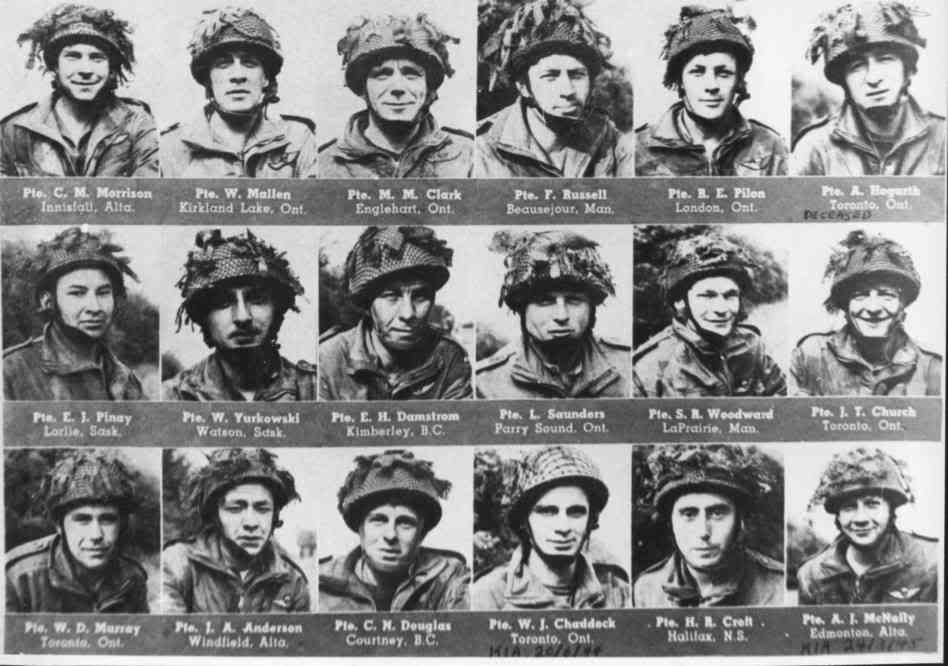
Canadian paratroops also deserve a mention. The 1st Canadian Parachute Battalion was part of the 21st Army Group and their objectives included; securing Drop Zone V by destroying a German HQ, destroying bridges at Robehomme and Varaville, providing cover to the British 9th battalion at Merville and securing high ground at Le Mesnil Crossroads http://www.magma.ca/~canpara/history.html#set_3.


Bibliography

Ambrose, S, Pegasus Bridge.

Neillands, R, De Normann, R, D-Day 1944 Voices From Normandy.


#DDay70 P.L.U.T.O - Pipeline Under The Ocean

Cross Section Of  P.L.U.T.O Pipeline

P.L.U.T.O - Pipeline Under the Ocean. Assuming that the Normandy invasion was successful, and the Allies had gained a foothold on French soil then logistical problems would arise. As well as food, ammunition spares and medical supplies, fuel was vital for the Allied advance inland. Due to the problems of transporting fuel via ship, (the Allies did not plan to capture any harbours) they did not want to clutter up the landing grounds with fuel tanker. So, arose an ingenious solution, to lay a pipeline from England to France across the English Channel.

Planning for P.L.U.T.O began in 1942, and eventual production and testing encountered many problems, such as kinking, twisting, collapse due to water pressure and other factors. 
 Each mile of pipe used 24 tons of lead, 7.5 tons of steel tape and 15  tons of steel armour wire and smaller amounts of lighter materials. The external diameter of the pipe was 4.5 inches.Combined Ops Website
Route Of P.L.U.T.O Pipeline

In all about 500 miles of pipeline were laid in an average laying time over the 30 mile stretch of about 5 hours. In January 1945 the system delivered a disappointing 300 tons but by March this had increased to 3000 tons and later still to 4000 tons. This amounted to over 1,000,000 gallons per day giving a total of 172,000,000 gallons delivered in total up to the end of hostilities. During the operation to lay the cables an HQ ship, several cable ships, tugs, trawlers and barges were employed on this specialised work - a total of 34 vessels with 600 men and officers under Captain J.F.Hutchings.Combined Ops Website
Most of the work to manufacture the pipeline was completed in Britain, but due to the volume needed the U.S helped, making a total of 140 tonnes of pipeline out of a total of over 700. D-Day saw much ingenuity, PLUTO was a great idea.
P.L.U.T.O Pumping Stations in 2009.

Wednesday, 28 May 2014

#WW2 D-Day Hero Co Sgt Major Stanley Hollis - Green Howards Regiment

Stanley E. Hollis VC 1912 - 1972
"The only serviceman to be awarded the Victoria Cross on D-Day June 6, 1944, for his actions at Gold Beach, La Rivière, The Mont Fleury Battery and Crépon, during the Normandy Invasion of Europe.
"An immensely brave and modest family man, born at Archibald Street, Middlesbrough, on September 21, 1912.Stanley E. Hollis VC 1912 - 1972 "The only serviceman to be awarded the Victoria Cross on D-Day June 6, 1944, for his actions at Gold Beach, La Rivière, The Mont Fleury Battery and Crépon, during the Normandy Invasion of Europe. "An immensely brave and modest family man, born at Archibald Street, Middlesbrough, on September 21, 1912. "A never-to-be-forgotten leader, protector and inspiration to his comrades." © Mike Morgan, author of the authorised biography "D-Day Hero: CSM Stanley Hollis VC"
"A never-to-be-forgotten leader, protector and inspiration to his comrades."
© Mike Morgan, author of the authorised biography "D-Day Hero: CSM Stanley Hollis VC"
Stanley Hollis Memorial Website Link

Stanley Hollis was a Co Sgt Major of 6th Battalion Green Howards, a northern regiment. He won the only V.C awarded for his actions on D-Day.  Read the full story here:   http://www.flamesofwar.com/hobby.aspx?art_id=286

There is an excellent BBC Tees Interview and documentary about Stan Hollis, you can find it here: http://www.bbc.co.uk/programmes/p020gt21


#D-Day 6th June 1944 More Of Hobart's Funnies


Last night I forgot to mention a couple of Hobart's inventions created for D-Day.
The AVRE was an armoured bulldozer, useful for pushing obstacles aside and also for Engineers to shelter behind.


There was also a bridge laying tank, again a Churchill:
Churchill Bridge Laying Tank

There was no need for Royal Engineers to spend hours building a bailey bridge under fire when they had these, they were ideal for crossing narrow rivers.


To summarise, These were British inventions, not American. Sometimes the British used American kit and improved it for different scenarios such as the DD swimming tank and the Sherman fitted with a 17pdr gun.
I can't help but scratch my head as to why General Bradley didn't adopt these tanks in larger numbers, even if only for D-Day instead of relying on frontal assaults by engineers and infantry. they may have saved many lives.

Tuesday, 27 May 2014

D-day 6th June 1944 - Hobart's Funnies

At the moment there is a lot of activity on all media regarding D-Day. The most common objection about the event is that it seems British ,European,  Allied and Commonwealth troops have largely been overlooked because the United States won the war for us... At least that's what Hollywood would like us to think. There is plenty of evidence to substantiate this, look at what has been broadcast on TV in the last 10 years - 'Band Of  Brothers' was an excellent series about  Easy Company from the U.S 101st Airborne .

So its up to the rest of us amateur historians, writers and professionals to put this right. I am going to try and publish a page on my blog every day until 6th June 2014 about D-Day and I am starting with the infamous 'Hobart's Funnies'.
Major General Sir Percy Hobart http://www.historylearningsite.co.uk/fileadmin/historyLearningSite/genera4.jpg

Major-General Sir Percy Hobart was one of the many characters in World War 2 that were eccentric. Hobart's ideas about armoured weaponry were so ahead of their time in the 1930's that he was largely confined to a desk and an early retirement (Neillands, De Normann p.51).By 1940 Hobart had been relieved of his post in the 7th Armoured in Egypt and was serving as a Corporal in the Home Guard(Neillands, De Normann p.52). Winston Churchill intervened recognising Hobart's technical genius and reassigned him to the 79th Division which consisted of modified armour especially developed for use on D-Day.

The Bobbin was a modified Churchill tank that laid down a road over quicksand  for other vehicles to follow.

http://www.thinkdefence.co.uk/wp-content/uploads/2014/05/Churchill-Assault-Vehicle-Royal-Engineers-AVRE-equipped-with-the-Type-C-Mk-2-Bobbin-track-laying-device.jpg

They were useful at Gold Beach laying 4 lanes over soft sand for other vehicles to follow, without these bobbin tanks vehicles would not have advanced inland.


Petard crew with a 'dustbin'.


The Petard tank was, like the bobbin, a Churchill based gadget. It was modified to carry  a massive gun which could destroy concrete bunker defences. It was invaluable supporting infantry as was the Crocodile.
The Crocodile was probably the scariest tank Hobart developed. It would result in a grisly death for the enemy.
Crocodile Flamethrower 


D-D tank  full steam ahead.

DD tanks were amphibious with a canvas screen and a propellor which enabled them to be launched away from shore. They could not be launched too far out, as was proven at Omaha when the majority were lost.

Flail tank.
The flail tank was equipped with a roller and chains on the front of the tank which would clear mines on the beach, it was a very noisy occupation , especially with mines exploding.

Facine obstacle clearing.


The Facine tank was a relatively simple invention, stemming back to  World War 1. When the tank came to a wide anti tank trench, all it did was release the large bundle of wood carried on the front and crossed over it.

These are just  a few of Hobart's inventions. On D-Day itself they would be loaded in order, i.e mine clearer first, then maybe the carpet layer, followed by the Petard and Crocodile. Without them there would have been many more casualties. 


Bibliography

Neillands,R, De Normann, R, D-Day 1944, Voices From Normandy, London (1993).
Ambrose, S, D-Day, U.S.A (1994).

Thursday, 12 December 2013

Recipe For Mincemeat & Mince Pies

(Image from:http://www.localfarmbox.co.uk/images/large/Mince%20Pies.jpg


Here is the good old recipe from the Allertonshire School for mincemeat and mince pies in one of my older posts.http://oldecuriosity.blogspot.co.uk/search/label/christmas%20recipes
 People who have tried the mincemeat swear it is much better than shop bought, and it is so easy to make. Please have a go and let me know how you got on.

Tuesday, 3 December 2013

Spike Milligan's War Memoirs - The Best Account You'll Ever Read About World War 2


http://www.ebay.com/itm/Spike-Milligan-Classic-War-Memoirs-Collection-7-Books-Set-Vol-1-to-7-Full-Pack-/151091606562
Spike Milligan was one of Britain's comedy greats. Like many young men of his time, he served in the armed forces, in Spike's case it was the Royal Artillery. He was a trained wireless operator, relaying orders to gun batteries. Luckily for his fans (and I am one) he wrote down most of his experiences in diaries which were eventually published with added humour. I think they are the best war memoirs I have ever read, and I have read quite a few, including those of Hans Von Luck and Pat Reid. What makes them unique is that they are the memoirs of an ordinary soldier, in the front line. The craic between Spike and his mates is hilarious, what ordinary soldiers in the war were thinking about also comes across well. A dry bed, hot food, a good night's rest peace and quiet. Spike also writes about his superiors, some were good, some not.  Spikes front line experiences came to an abrupt end when he had to advance through a shallow trench in full view of a German mortar crew. The subsequent mortaring and previous shelling when some of his comrades were killed and wounded was too much for him, and he suffered shell shock.

Anyway, I can't recommend his memoirs enough, if you want a book to cheer you up then these memoirs are ideal.

Monday, 2 December 2013

Stalingrad

German prisoner with Red Army captor, Stalingrad 1943? Image found at: http://1.bp.blogspot.com/-TG865m5bV-A/TuJHg7g7XfI/AAAAAAAAmLE/CzBH9gWr9dY/s1600/Stalingrad+1942+%252822%2529.jpg, accessed 2/12/13.

One can only imagine the fear, isolation, cold and hunger experienced by Axis forces in December on the Eastern Front. At Stalingrad it went from bad to worse, surrounded and cut off, led by incompetent yes men like Von Paulus they had no hope of getting out of the noose.

Red Army camels,Stalingrad. Image found at ibid.


Friday, 29 November 2013

Could Britain have Repelled A German Invasion In 1940?

One of then greatest questions discussed by historians for decades; Could Britain have repelled a numerically superior and better trained armed forces if Germany had invaded in 1940?

I have to answer yes, even though many people including my Father (God bless him) would disagree. Why do I chose to disagree? There is plenty of evidence to suggest that a German invasion, would have failed.

One also has to assume that Germany had sufficient transport for its infantry ( landing craft and JU-52 transport aircraft) as in 1940 it had neither.
As is well documented, the British Expeditionary Force (together with Belgian and French soldiers) were evacuated from France in May-June 1940, the majority of which were evacuated form the port of Dunkirk. There was very little in the way of equipment taken back to Britain as space was too valuable on board the boats and ships, indeed most of the troops did not posses a rifle.
Ibid.

After Dunkirk and other evacuations including Cherbourg Brest and St Lo,what did Britain posses to repel German troops? Britain had witnessed the much feared German blitzkrieg scythe through Europe. France would capitulate by June 22nd. 1

With the three main branches of the German armed forces working in cooperation with each other and not competing Operation Sea Lion could have taken place. Would an invasion have been successful? Fortunately we shall never know. One thing is certain however, a German victory would not have been easy or quick, unlike the relatively easy victories of the Low Countries and Denmark.

Britain had learned a valuable lesson in the Battle of France- not to rely on fixed defensive lines like those of the Maginot Line. France and Britain were still using tactics from the First World War whereas Germany had developed blitzkrieg (lightning war). Attacks with strength and speed were used, dive bombing Stukas with deafening sirens, closely followed by tanks and armoured personnel carriers and infantry. Germany had learned from the mistakes of the 1914-1918 war, whereas it's enemies had not. Fixed defences with all the guns pointing in one direction proved to be a complete failure. Airborne troops and glider troops proved this system of defence to be obsolete. There were also gaps in the line, at the Belgian border and the Ardennes. The Ardennes was said to be impenetrable, and then used by the Germans for their main armoured thrust in 1940.

What Defences Were Used By Britain For Home Defence?

Britain used many methods of defence whilst awaiting an invasion. The problem was forecasting where the invasion was going to arrive. It was impossible to forecast this without good intelligence, so Britain had to expect to be attacked on the southern and south eastern coasts as this was the shortest route from occupied France. In fact most of the coastline would be defended by some means, if only by barbed wire.

The most obvious defence was the English Channel. As the Germans were not prepared for an assault by the sea, they lacked landing craft and their navy was much smaller than that of the Royal Navy. The German plan was to transport men and horses across the English Channel using towed barges. Unless the Royal Air Force was defeated, this would mean some of the crossing would have to take place in darkness, seriously affecting the ability of the Luftwaffe to defend an invasion fleet. The darkness would work in the favour of the Royal Navy however, it would only take one destroyer going at full speed ahead to sink these barges by its wash alone, without firing it's guns.

(Image of barbed wire beach defences found at:http://www.walberswickww2.co.uk/imagebank/ ).

Barbed wire, would be the next form of defence as previously stated, it would be laid across the beaches in varying depths, this would ensure the defenders would be able to easily pick off the Germans as they landed, in 1940 there was no way through it other than wire cutters. The wire and minefields would be covered by soldiers in trenches and pillboxes. Unlike the Maginot Line, this was not designed to be the only defence, there would be more lines of defence further inland. Ironside had been put in charge of British defence on the 27th May 1940 and realised that delaying the Germans would be the order of the day. If they suffered enough delays to their objectives, it would give the British forces enough time to re-group and re- organise for a counter attack2. Fields were cluttered with obstacles to prevent glider landings. Bridges were guarded., road signs removed to confuse the enemy. Parts of East Anglia had been flooded including Romney marsh, more would be flooded to slow down a German advance when the Germans invaded.

(Coast tank trap defences, image found at:http://www.flickr.com/photos/russell_w_b/7304187730/ )

Tanks traps,hedgehogs and dragons teeth would also have some effectiveness in slowing down an armoured advance, assuming the Germans could transport them across the Channel. It is doubtful that anti-tank defence would have ever been needed if what Robinson wrote is to be believed. He claims that the Germans were not planning to bring tanks in any quantity, or vehicles. They were to rely on horses, 125,00 of them3. Horses do not repel bullets, need feeding and are slow compared to other vehicles. The German army high command did not want to transport fuel, or rely on capturing British fuel dumps.

How many troops did Britain have ready to fight in 1940? Over 300,000 were evacuated from Dunkirk in 1940, more from other ports such as Brest ,St Lo and Cherbourg took the total to over 500,0004.These troops would need to be rested and re-equipped before being put on an active role again. Local Defence Volunteers were formed on 14th May 19405, men who were too young or old could enrol and take part in defending their local town or village. They were later renamed the Home Guard and by the end of June 1940 they numbered more than 1,400,0006. The Home Guard was at first very badly equipped, having to use personal firearms, Molotov cocktails, pickaxe handles and even improvising pikes. They had no uniform at first, just an LDV armband, and these were home-made. Putting these inadequacies to one side, they would serve two purposes: They would attract men who could otherwise get in the way of the regular forces, should an invasion come. Being part of the armed forces would mean they could not be like partisans. Also. they would significantly contribute to the delay needed for the armed forces to regroup, and then counter attack.

Auxiliary Units were to be used after the invasion had passed through their area. They were ordinary people who would operate in civilian clothes. When the invasion happened they would hide out in specially made bunkers, often camouflaged in woods and perform various tasks. These included sabotaging any German vehicles, reporting German movements by radio to the military and relaying messages. The saboteurs among them were to fight with guns and explosives until their ammunition ran out, then if they were still alive, disband and go back to their own homes.

As a last resort, gas was to be used on the Germans. Churchill had authorised this in 1940, gas was to be sprayed on German troops by Fairey Battle aircraft. This may seem drastic nowadays, but what choice did Churchill have? There was nowhere left to evacuate to and he knew the Germans had to be stopped.

The Germans were planning to land at least 160,000 troops off the English coast. It is necessary to use one's imagination at this point. Germany had troops, tanks and horses but no way of transporting them quickly over the English Channel. The Germans planned to use steamers and tugs towing barges, Robinson states that there would be nearly 1000 barges towed across the Channel7. Obviously such transport was completely inadequate and unsuitable for such a task. An armed escort would consist of a total of 8 destroyers and numerous E-boats8. Opposing this invasion fleet would be at least 44 destroyers and cruisers9, (this does not take into account the British submarine fleet or U-boats). Even the most biased of opinions cannot be swayed by these facts. The German invasion fleet would have at least suffered a severe mauling.

Airborne troops had been used by the Germans in Holland to capture bridges and airfields. They also knocked out the Belgian fort at Eben Emael. They proved useful in surprise attacks behind the front line, but were far from invincible. The problem for Sea Lion would be shortage of transport aircraft (Ju-52), and the lack of heavy weapons. Airborne troops could carry only light weapons and mortars, which would make them unable to resist a determined counter-attack. JU-52's were generally unarmed, and would prove easy meat for fighter aircraft.

Assuming the Germans got ashore, they would be outnumbered, unable to land in strength due to the transportation problems and under attack from both land and air as the Royal Air Force proved impossible to defeat. The landing barges could only be unloaded from the stern, they were slow and would ride very low in the water. This would involve some manoeuvring, which would take time and make these makeshift landing craft easy targets for the coastal defences, the RAF and the Royal Navy. The RAF had provided air cover at the evacuation of France. It was not perfect, ships and troops were often under attack on the beaches, but the fact remains that because of the RAF nearly half a million troops escaped to Britain to fight again.

The longer Hitler and his forces delayed meant that more defences would be built, more men trained and more equipment would be made in British factories. Large quantities of supplies began to arrive from the United States and Canada. On 9th July 200,000 rifles from the U.S.A10. 75,000 Ross rifles were on their way from Canada11. Britain had also bought the entire production of the Thompson Machine Co of Chicago – 5,000 machine guns a month12. This would replace weapons lost in France, and ensure the Home guard was armed properly. Eventually ,Britain received re-conditioned American destroyers ( at least 50)in exchange for bases in British Colonies such as Trinidad, Bermuda and St Lucia.

The Germans concentrated on aerial domination , there is no need to go into great detail about the Battle of Britain. It is widely known that the Germans could not defeat the RAF, and were unwilling to cross the Channel until the RAF had been defeated by the Luftwaffe. By the time the Battle of Britain had ended it was September, which meant a rougher Channel crossing for an improvised invasion fleet, and shorter daylight hours, which could mean no air cover for an invasion fleet. This would leave it exposed to the Royal Navy destroyers.

Assuming half the troops and horses landed safely what would happen then? They would be under constant fore from beach defences. They would have to advance through barbed wire and minefields. Those that survived all this would have to wipe out the soldiers in the trenches and pillboxes and then fight reinforcements that would inevitably arrive. They would have to advance inland to meet up with airborne troops that would have been dropped before the invasion fleet landed. How effective these troops would have been remains doubtful. Transports would be shot down before and after dropping their paratroops. They were only lightly armed and may soon need rescuing themselves. Unlike the attacks on Denmark Holland and Belgium the British troops were on a high state of alert. Home Guard and Auxiliary troops would have slowed the German advance further while the main British forces retreated and regrouped. The Royal Navy would be attacking the German fleet, alongside the RAF. What was the chance of German success, even if they had got ashore? None. Even if they had made progress, there is no doubt the British military would have used gas on the invader. The results of this could be catastrophic but Churchill would have used every weapon available to defeat a German invasion force.


Bibliography

Gilbert, M, The Second World War.
Robinson, D, (2005), Invasion 1940 London.

DVD

The World At War, (1973), Thames television. The episode Alone is particularly relevant to this essay.

Websites

British Resistance Archive, found at: http://www.coleshillhouse.com/ .

McCann, G, The Home Guard and Dad's Army, found at:http://www.bbc.co.uk/history/british/britain_wwtwo/dads_army_01.shtml .

Cruickshank, D, The German Threat To Britain In World War 2, found at: http://www.bbc.co.uk/history/worldwars/wwtwo/invasion_ww2_01.shtml .


British Resistance Archive, found at:http://www.coleshillhouse.com/ .

Walberswick Coastal Defences Of World War 2, found at: http://www.walberswickww2.co.uk/ .

Footnotes

2The German Threat To Britain In World War 2, Cruickshank, D, found at:http://www.bbc.co.uk/history/worldwars/wwtwo/invasion_ww2_01.shtml .
3Robinson D, Invasion 1940, p.127.
5The Home Guard and Dad's Army, McCann,G, found at: http://www.bbc.co.uk/history/british/britain_wwtwo/dads_army_01.shtml
6Ibid.
7Robinson, D, xi.
8Ibid, x, xi.
9Ibid.
10Robinson, p.105.
11Ibid, p.106.

12Ibid,p108.
13, Just found this online, 12.6.15, Just found this online, the results of a Sandhurst College wargame in 1974. Adolf Galland, Friedrich Ruge and Heinrich Trettner took part. Operation Sealion - summary of an exercise held at the Staff College, Sandhurst in 1974. This can be found at:
http://mr-home.staff.shef.ac.uk/hobbies/seelowe.txt
The full text is in 'Sealion' by Richard Cox. The scenario
is based on the known plans of each side, plus previously
unpublished Admiralty weather records for September 1940.
Each side (played by British and German officers respectively)
was based in a command room, and the actual moves plotted
on a scale model of SE England constructed at the School
of Infantry. The panel of umpires included Adolf Galland,
Admiral Friedrich Ruge, Air Chief Marshal Sir Christopher
Foxley-Norris, Rear Admiral Edward Gueritz, General Heinz
Trettner and Major General Glyn Gilbert.

The main problem the Germans face is that are a) the
Luftwaffe has not yet won air supremacy; b) the possible
invasion dates are constrained by the weather and tides
(for a high water attack) and c) it has taken until
late September to assemble the necessary shipping.

Glossary
FJ = Fallschirmjaeger (German paratroops)
MTB = Motor Torpedo Boat (German equivalent, E-Boat)
DD = Destroyer
CA = Heavy Cruiser
BB = Battleship
CV = Aircraft Carrier

22nd September - morning
The first wave of a planned 330,000 men hit the beaches
at dawn. Elements of 9 divisions landed between
Folkestone and Rottingdean (near Brighton).
In addition 7th FJ Div landed at Lympne to take the airfield.

The invasion fleet suffered minor losses from MTBs during
the night crossing, but the RN had already lost one
CA and three DDs sunk, with one CA and two DDs damaged,
whilst sinking three German DDs. Within hours of the landings
which overwhelmed the beach defenders, reserve formations
were despatched to Kent.  Although there were 25 divisions
in the UK, only 17 were fully equipped, and only three
were based in Kent, however the defence plan relied on
the use of mobile reserves and armoured and mechanised
brigades were committed as soon as the main landings were
identified.

Meanwhile the air battle raged, the Luftwaffe flew 1200
fighter and 800 bomber sorties before 1200 hrs. The RAF
even threw in training planes hastily armed with bombs,
but the Luftwaffe were already having problems with their
short ranged Me 109s despite cramming as many as possible
into the Pas de Calais.

22nd - 23rd September
The Germans had still not captured a major port, although
they started driving for Folkestone. Shipping unloading
on the beaches suffered heavy losses from RAF bombing
raids and then further losses at their ports in France.

The U-Boats, Luftwaffe and few surface ships had lost
contact with the RN, but then a cruiser squadron with
supporting DDs entered the Channel narrows and had to
run the gauntlet of long range coastal guns, E-Boats
and 50 Stukas. Two CAs were sunk and one damaged. However
a diversionary German naval sortie from Norway was
completely destroyed and other sorties by MTBS and DDs
inflicted losses on the shipping milling about in the
Channel. German shipping losses on the first day
amounted to over 25% of their invasion fleet, especially
the barges, which proved desperately unseaworthy.

23rd Sept dawn - 1400 hrs.
The RAF had lost 237 planes out 1048 (167 fighters and
70 bombers), and the navy had suffered enough losses such
that it was keeping its BBs and CVs back, but large
forces of DDs and CAs were massing. Air recon showed a
German buildup in Cherbourg and forces were diverted to
the South West.

The German Navy were despondant about their losses,
especially as the loss of barges was seriously
dislocating domestic industry. The Army and Airforce
commanders were jubilant however, and preperations for
the transfer of the next echelon continued along with
the air transport of 22nd Div, despite Luftwaffe losses
of 165 fighters and 168 bombers. Out of only 732 fighters
and 724 bombers these were heavy losses. Both sides
overestimated losses inflicted by 50%.

The 22nd Div airlanded successfully at Lympne, although
long range artillery fire directed by a stay-behind
commando group interdicted the runways. The first British
counterattacks by 42nd Div supported by an armoured
brigade halted the German 34th Div in its drive on Hastings.
7th Panzer Div was having difficulty with extensive
anti-tank obstacles and assault teams armed with sticky
bombs etc. Meanwhile an Australian Div had retaken
Newhaven (the only German port), however the New Zealand
Div arrived at Folkestone only to be attacked in the
rear by 22nd Airlanding Div. The division fell back on
Dover having lost 35% casualties.

Sep 23rd 1400 - 1900 hrs
Throughout the day the Luftwaffe put up a maximum effort,
with 1500 fighter and 460 bomber sorties, but the RAF
persisted in attacks on shipping and airfields. Much of
this effort was directed for ground support and air
resupply, despite Adm Raeders request for more aircover
over the Channel. The Home Fleet had pulled out of air
range however, leaving the fight in the hands of 57 DDs
and 17 CAs plus MTBs. The Germans could put very little
surface strength against this. Waves of DDs and CAs
entered the Channel, and although two were sunk by U-Boats,
they sank one U-Boat in return and did not stop. The German
flotilla at Le Havre put to sea (3 DD, 14 E-Boats) and at
dusk intercepted the British, but were wiped out, losing
all their DDs and 7 E-Boats.

The Germans now had 10 divisions ashore, but in many
cases these were incomplete and waiting for their
second echelon to arrive that night. The weather
was unsuitable for the barges however, and the decision
to sail was referred up the chain of command.

23rd Sep 1900 - Sep 24th dawn
The Fuhrer Conference held at 1800 broke out into bitter
inter-service rivalry - the Army wanted their second
echelon sent, and the navy protesting that the
weather was unsuitable, and the latest naval defeat
rendered the Channel indefensible without air support.
Goring countered this by saying it could only be done
by stopped the terror bombing of London, which in turn
Hitler vetoed. The fleet was ordered to stand by.

The RAF meanwhile had lost 97 more fighters leaving only
440. The airfields of 11 Group were cratered ruins, and
once more the threat of collapse, which had receded in
early September, was looming. The Luftwaffe had lost
another 71 fighters and 142 bombers. Again both sides
overestimated losses inflicted, even after allowing for
inflated figures.

On the ground the Germans made good progress towards Dover
and towards Canterbury, however they suffered reverses
around Newhaven when the 45th Div and Australians
attacked. At 2150 Hitler decided to launch the second wave,
but only the short crossing from Calais and Dunkirk. By
the time the order reached the ports, the second wave
could not possibly arrive before dawn. The 6th and 8th
divisions at Newhaven, supplied from Le Havre, would not
be reinforced at all.

Sep 24th dawn - Sep 28th
The German fleet set sail, the weather calmed, and U-Boats,
E-Boats and fighters covered them. However at daylight 5th
destroyer flotilla found the barges still 10 miles off
the coast and tore them to shreds. The Luftwaffe in turn
committed all its remaining bombers, and the RAF responded
with 19 squadrons of fighters. The Germans disabled two
CAs and four DDs, but 65% of the barges were sunk. The
faster steamers broke away and headed for Folkestone,
but the port had been so badly damaged that they could
only unload two at a time.

The failure on the crossing meant that the German
situation became desperate. The divisions had sufficient
ammunition for 2 to 7 days more fighting, but without
extra men and equipment could not extend the bridgehead.
Hitler ordered the deployment on reserve units to Poland
and the Germans began preparations for an evacuation as
further British arracks hemmed them in tighter. Fast
steamers and car ferries were assembled  for evacuation
via Rye and Folkestone. Of 90,000 troops who landed
on 22nd september, only 15,400 returned to France, the rest
were killed or captured.